The effects of Parkinson’s disease, music training and dance training on beat perception and production abilities
Prisca Hsu, Emily A. Ready, Jessica A. Grahn
Abstract
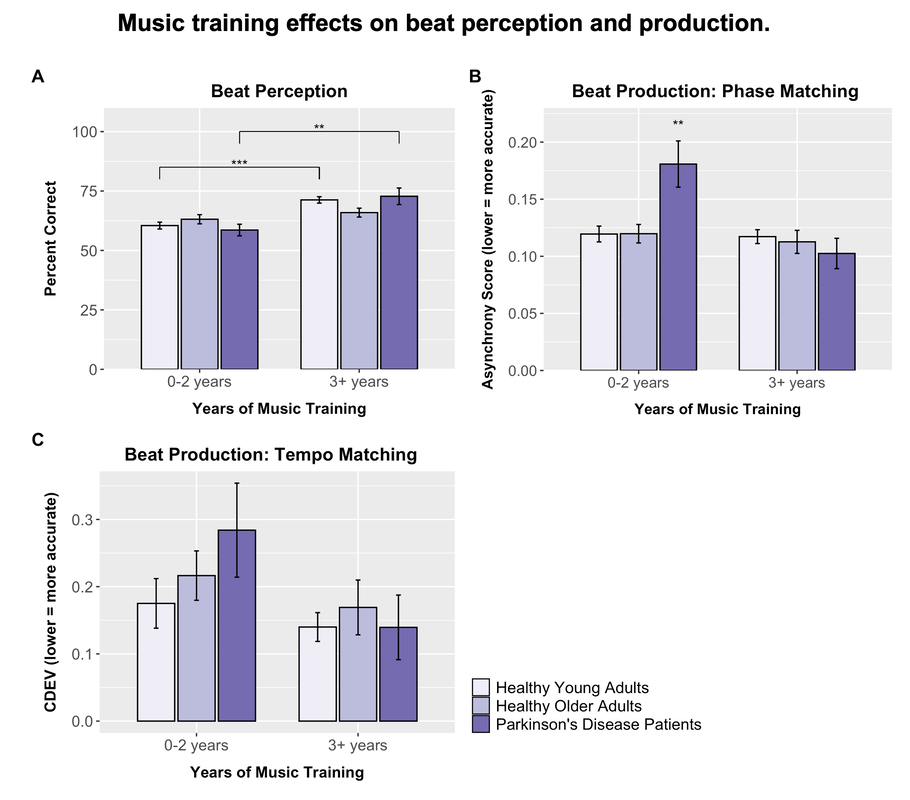
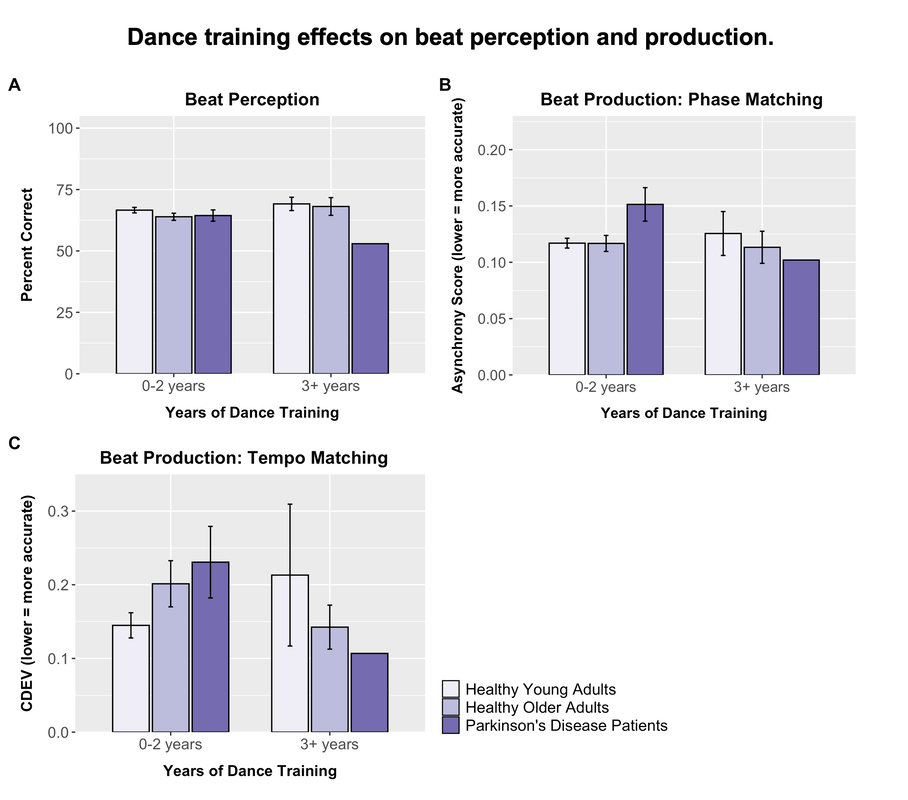
Humans naturally perceive and move to a musical beat, entraining body movements to auditory rhythms through clapping, tapping, and dancing. Yet the accuracy of this seemingly effortless behavior varies widely across individuals. Beat perception and production abilities can be improved by experience, such as music and dance training, and impaired by progressive neurological changes, such as in Parkinson’s disease. In this study, we assessed the effects of music and dance experience on beat processing in young and older adults, as well as individuals with early-stage Parkinson’s disease. We used the Beat Alignment Test (BAT) to assess beat perception and production in a convenience sample of 458 participants (278 healthy young adults, 139 healthy older adults, and 41 people with early-stage Parkinson’s disease), with varying levels of music and dance training. In general, we found that participants with over three years of music training had more accurate beat perception than those with less training (p<.001). Interestingly, Parkinson’s disease patients with music training had beat production abilities comparable to healthy adults while Parkinson’s disease patients with minimal to no music training performed significantly worse. No effects were found in healthy adults for dance training, and too few Parkinson’s disease patients had dance training to reliably assess its effects. The finding that musically trained Parkinson’s disease patients performed similarly to healthy adults during a beat production task, while untrained patients did not, suggests music training may preserve certain rhythmic motor timing abilities in early-stage Parkinson’s disease.
Beat Processing in Parkinson's Disease
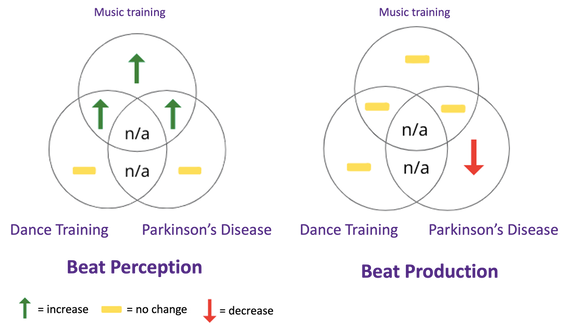
The process of synchronizing, or entraining, movement to the beat engages motor areas of the brain. In particular, the basal ganglia have been shown to play a key role in perceiving the beat, and Parkinson’s disease patients, who have dysfunctional inputs to the basal ganglia, show specific beat perception impairments. The disruption of dopamine projection within these networks appears to result in beat processing deficits. Patients are impaired on simple timing tasks and more complex beat-based rhythm discrimination tasks.
|
Beat Processing in Musicians and DancersMusicians have been found to exhibit better rhythm processing abilities such as beat perception and metrical structure perception. Aside from perceptual advantages, music training relates to better motor and timing abilities. Similar to musicians, dancers also have superior timing perception abilities compared to non-dancers. Dancers must synchronize their movements to the music and with the movements of other dancers, resulting in elevated motor entrainment abilities with both auditory and visual stimuli. Dancers are also experts in whole-body coordination to auditory cues and produce more accurately timed movements compared to non-dancers.
|
Study Rationale
|
People show a striking range in how accurately they both perceive and move with a musical beat. These abilities are positively impacted by music and dance training but negatively impacted in Parkinsons’ disease. However, little is known about the combined impact of these previous life experiences and Parkinsons’ on beat processing abilities.
Research Aims
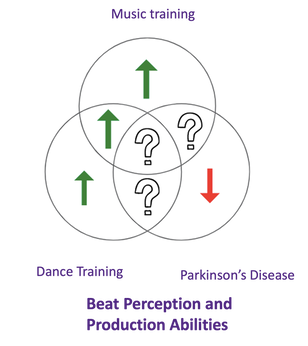
We Predicted That... |
|
- Music and dance training would correlate with better beat perception and production abilities, while
- Parkinson’s disease would reduce these abilities relative to controls
- Parkinson’s disease patients with previous training may have better abilities than patients without training
Participants
|
The Beat Alignment Test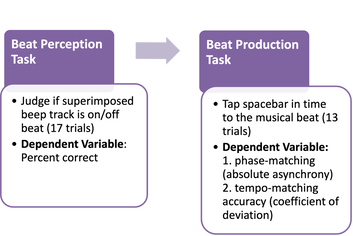
|
Results
|
|
Results Summary